Tactical Knives D2C Brand: ROAS 3.45 → 8.29 in a Restricted Google Policy Category
ROAS nearly tripled once Shopping access was unlocked
Client & Context
A US-based D2C brand selling premium tactical knives with a lifetime warranty. Sales model: direct-to-consumer. Advertising channels: Search, Performance Max, Shopping.
The Challenge
Advertising in sensitive Google Ads categories carries an extra layer of complexity: restrictions apply not just to keywords, but to ad copy, product imagery, the product feed itself, and even access to Shopping as a channel. At the outset of this project, Shopping was entirely unavailable — Merchant Center required product verification first — so the immediate task was to build an effective advertising system on Search and Performance Max alone, and reach a minimum ROAS of 3.0 without any access to Shopping whatsoever.
Restrictions were substantial throughout: certain terms couldn't be used in ad copy at all, and both imagery and product listings went through repeated additional moderation. A separate, structural problem was Merchant Center itself — without verified products, launching any Shopping campaign was simply impossible. So for the entire first phase, the team worked with no product feed at all, relying solely on Search and Performance Max.
Plan of Work
- Build an ad structure from scratch under active Google Policy restrictions.
- Reach a minimum ROAS of 3.0 with no access to Shopping.
- Prepare Merchant Center and unlock the ability to scale through Shopping.
Once Merchant Center was verified, the plan called for launching Shopping and further scaling the overall advertising system.
Approach
I. Building the ad structure
Search and Performance Max were launched first, with no product feed attached. The primary focus was non-branded traffic and new-customer acquisition. The core difficulty was doing all of this simultaneously: complying with Google Policy requirements, crafting clear ad messaging within those restrictions, securing sufficient traffic volume, and not losing effectiveness because of the constraints on the creative assets themselves.
II. Testing ad materials
Because of Google's restrictions, a significant share of ad materials were rejected during moderation. The team systematically tested different combinations of copy and imagery to identify which variants simultaneously passed moderation and delivered the needed performance — this became an ongoing workstream that ran throughout the entire project, not a one-time setup task.
Working With Merchant Center
In parallel with the ad work, the team prepared the product feed to meet Google Policy requirements. After updating the feed, they began direct communication with Google support to get the flagged products unblocked — a process that took several weeks. Once Merchant Center was verified, Shopping campaigns became possible, adding a new acquisition channel alongside the already-running Search and Performance Max.
Results Timeline
| Metric | April 2026 | May 2026 | 1–16 June 2026 |
|---|---|---|---|
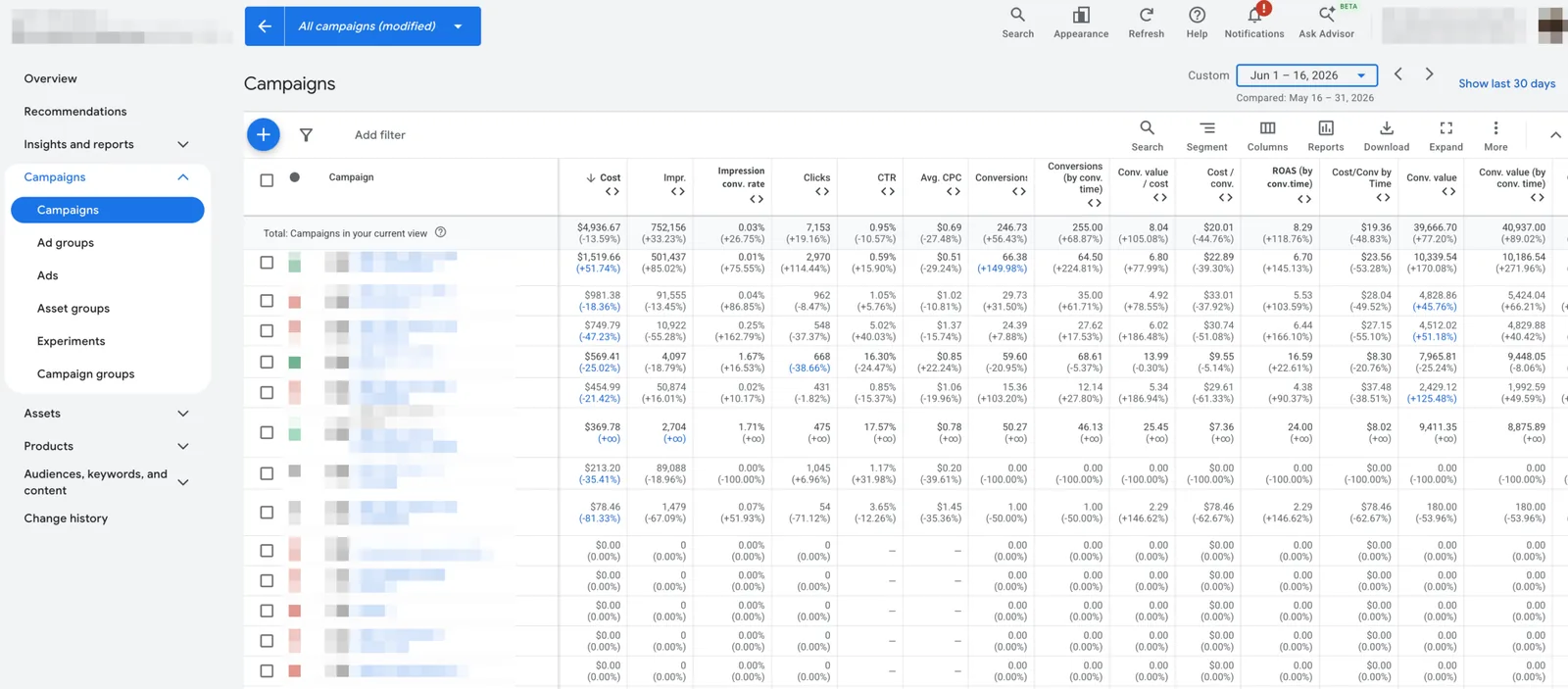
| ROAS | 3.45 | 3.90 | 8.29 |
| Revenue | $17,621.80 | $39,213.00 | $40,937.00 |
| Budget | $5,114.44 | $10,063.25 | $4,936.67 |
| Average order value | $157.34 | $152.00 | $160.54 |
| Conversions | 112 | 258 | 255 |
| Cost per conversion | $45.66 | $39.00 | $19.36 |
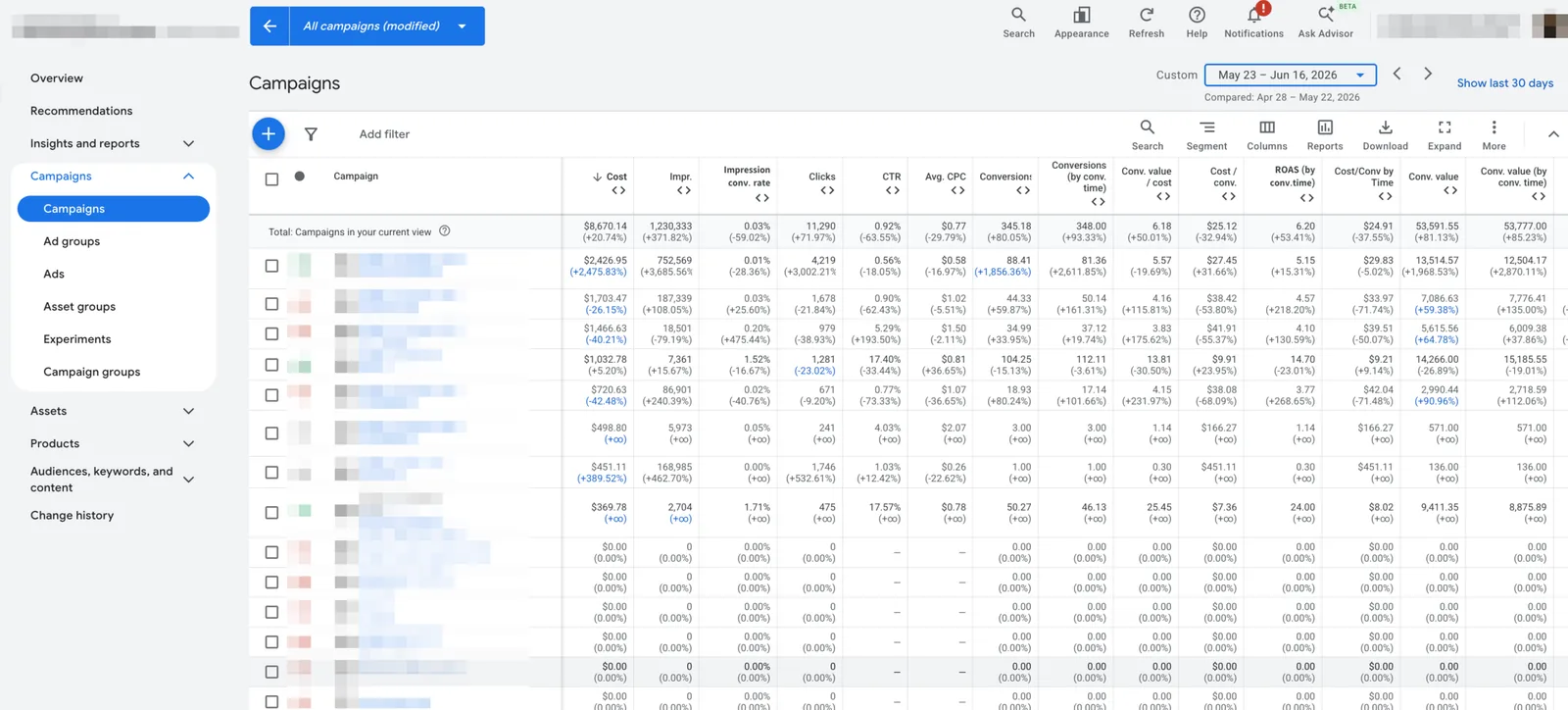
Shopping Network — 23.05–16.06.2026
| Metric | Result |
|---|---|
| Budget | $3,447.61 |
| Revenue | $17,017.36 |
| Conversions | 113.13 |
| CPA | $30.47 |
| ROAS | 4.94 |
What Worked
1. A structure built for Google Policy constraints
Rather than waiting idle for Shopping access, the team built a working structure on Search and Performance Max and hit a ROAS of 3.45 in the very first month — already ahead of the initial 3.0 target.
2. Systematic testing of ad materials
In a category with constant rejections, relying on a single fixed set of ads wasn't viable. The team continuously tested copy and imagery variants, keeping only the combinations that both passed moderation and delivered the needed efficiency.
3. Merchant Center groundwork
Feed preparation and optimization, plus direct communication with Google support, is what ultimately unlocked Shopping access.
4. Shopping as an added channel, not a replacement
Once Merchant Center was verified, Shopping supplemented Search and Performance Max rather than replacing them — in its first measured window it delivered a 4.94 ROAS and $17,017.36 in revenue on $3,447.61 of spend.
Scaling
In May, the ad budget nearly doubled from $5,114 to $10,063. Conversions grew from 112 to 258 (+130.4%), and revenue climbed from $17,621.80 to $39,213 (+122.5%). Crucially, ROAS didn't decline under that scale — it improved, from 3.45 to 3.90, evidence the underlying structure could absorb significantly more spend efficiently rather than just diluting it. After Shopping launched, the first 16 days of June alone out-earned the entire prior month: $40,937 in revenue at a ROAS of 8.29.
Key Insight
In sensitive categories, Google Ads performance depends on more than bid and campaign optimization alone — the technical ability of the channel to function at all plays a major role. Here, the team first had to build an effective advertising system without Shopping, while simultaneously working through a complex Merchant Center verification process. Once Shopping opened up, it added a channel that meaningfully scaled the result. The real task wasn't simply "launch some ads" — it was systematically removing the restrictions blocking access to the tools the account needed.