Article
 Penguin Team5 min read
What Is White Label SEO? How It Works for Agencies
TL;DR White label SEO means a specialist team does the SEO work and your agency sells it under its own brand. You keep the client, the contract and the invoice; the provider does the execution, never contacts your client independently and joins client calls only at your request, under your brand. It fits agencies that get requests for SEO they can't staff in-house, and it works best when scope, price and dates are agreed before each task starts.
What white label SEO means
In white label SEO, one company does the work and another company sells it. Your agency owns the client relationship and puts its own name on the proposals, the invoices and the reports. The provider does the SEO itself: audits, on-page fixes, content briefs, link building. Your client sees your agency and nothing else.
The name comes from retail, where a product is made by one company and sold under another's label. In agency work it describes how delivery is arranged, not what is delivered. The provider is invisible by design.
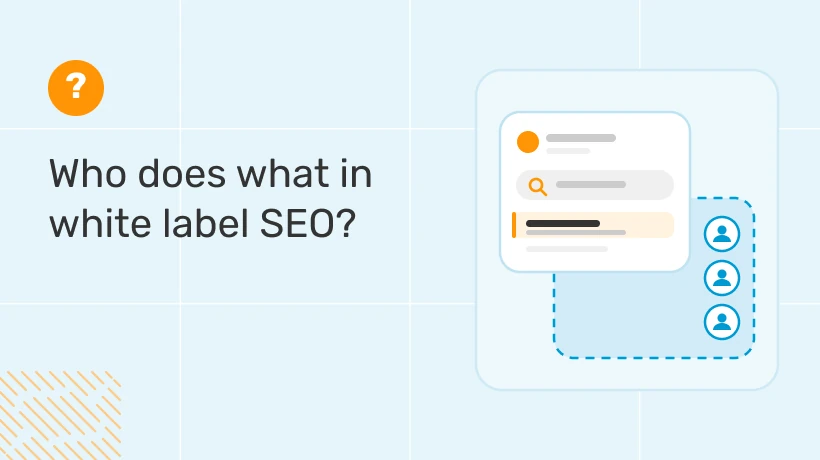
Who does what
| Area | Your agency | White label provider |
|---|---|---|
| Client relationship, contract and invoice | Yours | None |
| Strategy | Yours with an Execution Partner; built together with a Growth Partner | Follows your strategy, or builds it with you |
| Execution | Reviews the result | A named specialist does the work |
| Quality check | Final review before your client sees it | Review before delivery to you |
| Reporting | Sent to your client under your brand | Prepared in your template |
| Contact with your client | Yours | Only at your request, under your brand |
The two partnership models differ only in the strategy row. Execution Partner suits agencies with their own strategic lead who need more hands. Growth Partner suits agencies without in-house SEO expertise, where the provider runs strategy and execution together.
What a white label SEO provider delivers
Most SEO delivery falls into six areas:
- Technical SEO: crawl, diagnosis and the fixes that follow it.
- On-page optimization: titles, structure and internal linking, worked page by page.
- Keyword research: mapped to search intent and sized against what the client can realistically rank for.
- Content support: briefs your writers can use, or drafts you edit.
- Link building: digital PR and placements, with the sites named before anything is bought.
- Reporting: completed work, progress and next steps.
These are usually split into one-time setup work (an audit, technical fixes, a first round of on-page work and links) and ongoing monthly management (continued on-page work, technical monitoring, content strategy and reporting). Setup and management are priced separately, so a client can start with a single project and move to a retainer later.
How the work moves between your agency and the provider
The details differ between providers, but the flow is usually the same:
- You send the task. Share the client's requirements with your manager, in one thread.
- Scope and deadline. You get the task list, the price and the date each item lands on. Nothing starts before you approve it.
- Specialist execution. The task goes to the SEO specialist assigned to your account.
- Quality assurance. The work is reviewed before it reaches your agency.
- Delivery. The result arrives in your format, on the agreed date.
The second step matters most. Most problems in white label work come from unclear scope, and this is the step that fixes it.
What white label SEO costs
Prices vary widely between providers, so compare what is included rather than the headline number. At Penguin Team, one-time SEO setup packages run from $299 to $899, and monthly management packages run from $299 to $899 per month, depending on the number of pages and keywords in scope. Content writing ($40–$100 per page), link building (from $400) and technical fixes that need developer time (from $400) are priced separately, so you only pay for what a client needs.
Your agency then sets its own resale price. We cover how to do that in a separate article on pricing white label SEO and PPC for your clients.
What white label SEO is not
- Not a ranking guarantee. Rankings depend on the site, the market and time; competitive keywords typically move over 3–6 months.
- Not a way to skip strategy. Someone still decides the priorities: you with an Execution Partner, or the provider together with you with a Growth Partner.
- Not an open-ended bill. Scope, price and dates are agreed before work starts.
When white label SEO fits, and when it doesn't
It fits when:
- A client asks for SEO you can't staff in-house.
- Hiring a full-time specialist isn't justified by the workload yet.
- The workload changes from month to month.
- You want to test a new service line before committing to a hire.
It fits less well when:
- SEO is what clients hire you for and your own method is the product.
- The task is small and one-off, so the time spent briefing a partner exceeds the time to do it.
- You can't yet describe what you want delivered. Unclear scope is the most common reason a partnership disappoints.
What to check before you start
Five questions cover most of the risk. Will a named manager and a named specialist work on your account? Are scope, price and date agreed before work starts? Do reports arrive in your template? Does the provider ever contact your clients? Is there an NDA? Our article on choosing a provider goes through each one.